SDVOSB Certified
Friendswood, TX
Industry

Pressure Reduction for Power Plants

Pulp and paper mills run some of the most demanding liquid systems in industry: recovery boiler feedwater near saturation temperature, continuous blowdown letdown, high-pressure shower and cleaning water, condensate, and mill service water that runs around the clock between planned outages. Wherever these systems take a large pressure drop across a single point, the margin between local pressure and the fluid’s vapor pressure can determine whether energy dissipates quietly or through cavitation.
Submit System Data
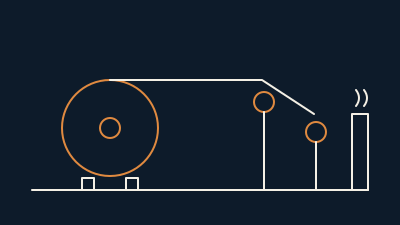
Line illustration of a paper roll, sheet path, and mill stack representing pulp and paper mill systems.
Device
Anti-Cavitate Orifice Plate™
Code support
ASME B31.1 & B31.3
Materials
304L to super duplex & nickel alloys
Federal contracting
SDVOSB-Certified
Application detail

Cavitation control in pulp and paper systems

Pulp and paper mills operate demanding liquid systems that often run continuously between planned outages. Boiler feedwater, blowdown letdown, high-pressure shower water, mill service water, condensate, and process-fluid lines can develop cavitation where pressure drop is concentrated, especially when hot streams operate near saturation temperature.

Key considerations

  • Near-saturation service. Feedwater, blowdown, and hot process streams can operate close to the fluid’s vapor pressure, so even moderate pressure drops may drive local pressure low enough for vapor to form and collapse downstream.
  • Long run times. Cavitation damage is progressive. A restriction that cavitates between outages is often discovered at the next shutdown, after the wear has accumulated.
  • Vibration transmission. Cavitation-related vibration can travel along long mill piping runs, loosening supports and fatiguing small-bore connections away from the source.
  • Practical evaluation. Actual system data — pressures, temperature, flow, fluid properties, and piping layout — is required to determine whether cavitation risk is present.

Managing pressure reduction and energy dissipation can help reduce cavitation-related vibration, noise, and downstream wear.

How the plate helps

One device, three effects

The Anti-Cavitate Orifice Plate™ helps manage flow, pressure drop, and cavitation behavior in a single fixed-geometry device.

01

Noise reduction

Controlling how flow and pressure are reduced can lower noise levels generated within the system.

02

Cavitation mitigation

Managing the pressure drop helps mitigate cavitation that can damage pipes and downstream equipment.

03

Flow control

The plate regulates flow rate to help the system operate within the intended design conditions.
Request an engineering review

Evaluate your system for cavitation

Provide flow rate, inlet pressure, desired outlet pressure, pipe size and schedule, and fluid type and temperature. Restrict Flow will review the submitted system data and follow up if additional information is needed.