
Cavitation in Boiler Blowdown Systems — A High-Risk Environment
- Apr 27
- 5 min read
Cavitation in Boiler Blowdown Systems — A High-Risk Environment
Boiler blowdown systems are among the most thermodynamically aggressive environments in any industrial facility. Engineers responsible for the design, operation, and maintenance of these systems routinely face the challenge of managing high-pressure, high-temperature saturated water as it transitions through control valves, orifice plates, and flash vessels. One of the most destructive — and often underestimated — phenomena in these systems is cavitation. Understanding the root causes, consequences, and mitigation strategies for cavitation in boiler blowdown lines is not merely an academic exercise; it is a critical engineering responsibility with direct implications for plant safety, equipment longevity, and operational efficiency.
Why Boiler Blowdown Systems Are Uniquely Vulnerable
In a typical boiler blowdown scenario, water at or near saturation conditions — often between 150 psig and 900 psig depending on boiler operating pressure — is discharged to atmosphere or a lower-pressure flash tank. As this fluid passes through a restriction device, its static pressure drops rapidly. If that pressure drop causes the local static pressure to fall below the fluid's vapor pressure at the prevailing temperature, vapor bubbles nucleate and collapse violently within the liquid stream. This is cavitation, and in a blowdown environment, it happens with alarming ease. Unlike cold water systems where the vapor pressure is relatively low, saturated boiler water is already at its boiling point. Even a modest pressure reduction is sufficient to trigger flash and cavitation simultaneously, making these systems far more susceptible than general utility piping.
The Mechanics of Cavitation Damage in Blowdown Piping
When vapor bubbles formed during pressure reduction subsequently collapse — either as pressure recovers downstream or as the bubbles contact a solid surface — they release intense localized energy. The micro-jet and shock wave produced by each collapsing bubble can generate pressures exceeding 100,000 psi at the surface of contact. Over time, this results in pitting, erosion, and material fatigue on valve trim, pipe walls, orifice plate faces, and downstream fittings. In blowdown systems, this damage is compounded by the presence of dissolved solids and the elevated temperatures involved. Piping engineers frequently observe accelerated wall thinning immediately downstream of blowdown valves and single-stage orifice plates — damage that can progress from surface pitting to through-wall failure within months in severe cases. The noise signature of cavitation, often described as a crackling or gravel-in-pipe sound, is a telltale indicator that the system is operating in a damaging regime.
Pressure Staging: The Engineering Foundation of Cavitation Prevention
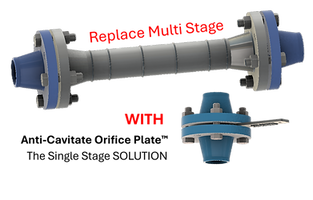
The most effective engineering strategy for preventing cavitation in boiler blowdown systems is staged pressure reduction. Rather than dropping from full boiler pressure to blowdown tank or atmospheric pressure in a single step — which virtually guarantees cavitation — engineers should design the system to reduce pressure incrementally across multiple devices. Each stage reduces pressure by a controlled amount, ensuring that at no point does the local static pressure fall below the vapor pressure of the fluid at that location. This approach requires careful thermodynamic analysis at each stage, accounting for the fluid's enthalpy, temperature, and vapor pressure as conditions change across the system. Two-stage and three-stage configurations are common in medium- and high-pressure boiler applications. The selection and sizing of each restriction element must account for the inlet conditions at that specific stage, not simply the overall system differential pressure.
Role of the Anti-Cavitation Orifice Plate in Blowdown Applications
Standard sharp-edged orifice plates, while widely used for flow measurement and restriction in less demanding services, are poorly suited for blowdown duty at high differential pressures. Their geometry concentrates the vena contracta pressure recovery in a very short downstream distance, creating the ideal conditions for violent bubble collapse right at or near the plate surface. Anti-cavitation orifice plates address this by using multi-hole, tortuous-path, or staged-hole geometries that distribute the pressure drop across a longer flow path and reduce the severity of the vena contracta effect. The result is a device that can achieve the required pressure reduction while keeping local static pressures above the vapor pressure threshold throughout the flow path. Restrict Flow LLC has developed anti-cavitation orifice plate solutions specifically engineered for high-pressure blowdown service. Engineers seeking technical specifications, sizing guidance, and application examples can visit restrictflow.com/anti-cavitate-orifice-plate to review detailed product information and application criteria tailored to boiler blowdown and similar high-energy liquid services.
Material Selection and Velocity Considerations
Even with proper pressure staging, piping engineers must address fluid velocity and material compatibility throughout the blowdown system. High fluid velocities amplify the erosive impact of cavitation and, in two-phase flow regions, contribute to erosion-corrosion that can rapidly compromise carbon steel piping. For blowdown lines where flash is unavoidable — such as downstream of the final pressure reduction stage — stainless steel or high-alloy materials with superior erosion resistance should be specified. Downstream piping should be designed to accommodate two-phase flow at velocities low enough to avoid excessive erosive wear, typically below 50 ft/s in two-phase service and preferably lower where possible. Pipe schedule selection should reflect both the pressure rating requirements and a corrosion allowance that accounts for the aggressive nature of the service. Bend radii, tee configurations, and the placement of instrumentation taps should all be evaluated with erosion in mind.
Inspection, Monitoring, and Maintenance Protocols
Because boiler blowdown systems operate in a high-consequence environment, a proactive inspection and monitoring program is essential regardless of how well the system has been designed. Ultrasonic thickness testing of piping immediately downstream of all restriction devices should be performed at regular intervals, with frequency determined by historical erosion rates and risk assessment outcomes. Acoustic emission monitoring can provide early warning of active cavitation without requiring system shutdown, allowing operators to identify developing problems before they progress to failure. Valve internals and orifice plates should be inspected during scheduled outages for signs of pitting, erosion rounding of orifice edges, or loss of material. Any observed damage should be evaluated against the original design basis to determine whether the device continues to meet its intended pressure reduction function or requires replacement.
Engineering the Right Solution for Your Blowdown System
Every boiler blowdown system presents a unique combination of operating pressure, temperature, flow rate, fluid chemistry, and downstream discharge conditions. There is no universal solution, and the consequences of applying an undersized or improperly staged restriction system range from accelerated equipment wear to catastrophic piping failure. Restrict Flow LLC specializes in engineering restriction flow solutions for exactly these high-risk, high-consequence applications. Whether you are designing a new blowdown system, retrofitting an existing one that has experienced cavitation damage, or evaluating options for a capacity expansion, our engineering team can assist with thermodynamic analysis, device selection, and system configuration review. To begin the process and receive application-specific guidance, we invite you to complete our engineering questionnaire. Providing your system parameters allows our team to deliver accurate, actionable recommendations tailored to your specific boiler blowdown challenge.

Comments